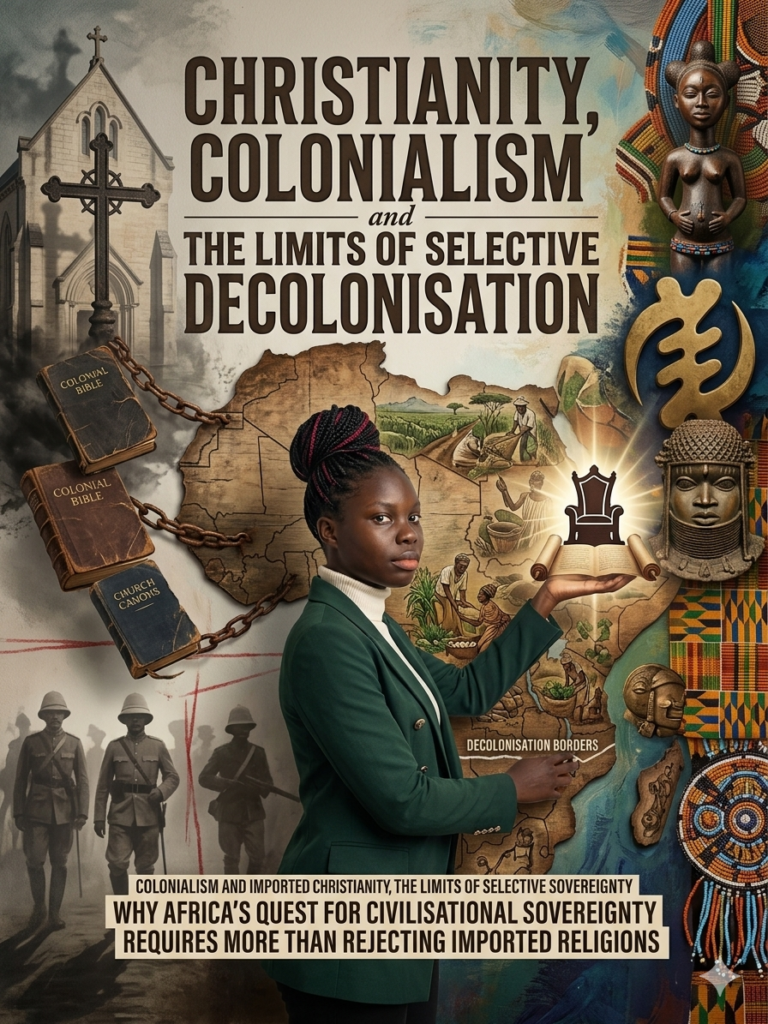
Christianity, Colonialism and the Limits of Selective Decolonisation:
Why Africa’s quest for civilisational sovereignty requires more than rejecting imported religions
PART ONE: The Convenient Scapegoat — Why Religion Bears the Weight of a Larger Argument
There is a scene that has become almost theatrical in contemporary African intellectual discourse. A scholar — educated at a university whose very architecture mirrors Oxford or Cambridge, dressed in Western clothing, speaking in English or French or Portuguese, holding credentials issued under systems inherited from colonial administration — stands before an audience and declares, with great passion, that Christianity is a foreign imposition and must be rejected if Africa is to reclaim her soul. The audience applauds. The scholar is praised for their courage. And then everyone goes home, logs onto social media platforms built in Silicon Valley, and resumes their lives largely unchanged.
This scene captures, with uncomfortable precision, the central contradiction haunting many decolonisation movements across the African continent. The argument against Christianity — and to a lesser extent Islam — as instruments of cultural imperialism is not without merit. It is historically grounded, emotionally resonant, and in many ways correct. But it is also selective in a way that ultimately undermines its own credibility, because religion did not arrive alone. It came as part of a package — comprehensive, deliberate, and deeply interlocking — and to pull one thread while leaving the rest intact is not decolonisation. It is theatre.
To understand why religion became the primary target, one must understand the psychology of cultural grievance. Religion is visible. It is practised in public, announced by church bells and mosque calls, inscribed on calendars and national holidays. It touches the most intimate human experiences — birth, marriage, death, morality, and identity. When a continent as spiritually rich as Africa, which had its own sophisticated cosmologies, religious philosophies, and metaphysical systems long before any European missionary arrived, looks around and finds that those systems have been largely displaced by imported faiths, the sense of violation is visceral and understandable.
African Traditional Religion, in its many forms across the continent, was not primitive superstition. It was a developed, coherent engagement with questions of existence, community, morality, and the sacred. The Yoruba had Ifa — an extraordinarily complex divination and philosophical system that some scholars argue rivals any theological tradition in the world for depth and internal consistency. The Akan had their own intricate cosmology built around concepts of the soul, communal ethics, and ancestral continuity. The Zulu, the Igbo, the Kikuyu, the San — every major African civilisation had cultivated a relationship with the spiritual that was sophisticated, functional, and entirely their own. Colonialism systematically dismantled these systems, labelling them demonic, backward, and uncivilised, while simultaneously using the imported religion as both a consolation and a mechanism of control.
This history is real. The wounds are real. The indignation is justified.
But here is where the argument must be pushed further, because a justified grievance is not the same as a complete analysis. If the critique is truly about civilisational integrity — about Africa’s right to exist on her own intellectual and cultural terms — then singling out Christianity while leaving the rest of the colonial architecture untouched is not merely inconsistent. It is a failure of intellectual seriousness.
Consider the university from which the critic speaks. The modern African university, with rare exceptions, is a colonial institution. Its structure, its hierarchy of knowledge, its departmental divisions, its grading systems, its relationship between lecturer and student — all of these were designed in and imported from European academic traditions. The knowledge considered worthy of study, the languages in which it is taught, the frameworks through which history and science and law and economics are understood — these are largely Eurocentric in their foundations. The African university was not designed to produce thinkers rooted in African epistemology. It was designed to produce administrators and professionals who could operate within colonial and post-colonial systems. To use it as a platform from which to condemn the Bible while leaving the syllabus unexamined is a profound inconsistency.
The same is true of language. When an African intellectual writes a celebrated essay on African identity in English, French, or Portuguese, and that essay is considered more legitimate, more widely circulated, and more academically credible than one written in Yoruba, Amharic, Zulu, or Wolof, something deeply colonial is still operating. Language is not a neutral vehicle. It carries within it a worldview, a hierarchy of concepts, a way of organising reality. Chinua Achebe himself wrestled with this contradiction — choosing to write in English while acknowledging that the choice itself was a concession to the colonial condition. The philosopher Ngũgĩ wa Thiong’o went further, eventually abandoning English entirely to write in Gikuyu, arguing that language was the most fundamental battlefield of decolonisation. But Ngũgĩ remains exceptional. Most African intellectuals who rail against religious imperialism do so in the coloniser’s tongue, without apparent irony.
This is not an accusation. It is an observation about the total depth of what colonialism did — and what that depth demands of anyone serious about dismantling it.
PART TWO: The Architecture of a Total System — What Colonialism Actually Built
To understand the true scale of the decolonisation challenge, one must appreciate that colonialism was never merely a political or economic project. It was a civilisational replacement programme — comprehensive, systematic, and designed to be self-perpetuating long after the colonial administrators had gone home. Religion was one instrument. But the instruments were many, and they were deliberately designed to work together.
Education was perhaps the most powerful instrument of all, because it operated at the level of the mind. Colonial education did not simply teach reading and arithmetic. It taught Africans to understand themselves through a European lens — to see African history as beginning with European contact, to measure African achievement against European standards, to regard European civilisation as the apex toward which all human development was striving. Lord Macaulay’s infamous 1835 Minute on Indian Education — in which he argued for producing a class of people “Indian in blood and colour, but English in taste, in opinions, in morals, and in intellect” — articulated what colonial education across Africa also aimed to produce. The goal was not to educate Africans. It was to produce useful intermediaries who would be alienated enough from their own cultures to serve the colonial system without threatening it.
The consequences of this are still playing out. African children across the continent today learn more about European history than their own. They can name European kings and their wars but struggle to name the intellectual traditions of their own civilisations. They learn science through frameworks that largely exclude African contributions to astronomy, mathematics, metallurgy, and medicine — contributions that were real and significant, from the mathematical sophistication of ancient Egypt to the iron-smelting traditions of sub-Saharan Africa that predate European industrialisation. This is not accidental. It is the residue of a system designed to produce cultural amnesia.
Law is another underexamined area. The legal systems governing most African nations today are largely inherited from colonial jurisprudence. The common law system in Anglophone Africa, the civil law tradition in Francophone Africa — these are not neutral administrative tools. They encode specific philosophical assumptions about individual rights, property ownership, contracts, and justice that were in many cases directly opposed to African communal legal traditions. The land tenure systems imposed by colonial law, for instance, were among the most violent intrusions into African life, because they replaced communal, ancestral relationships to land with individual ownership models that made mass dispossession legally possible and straightforward. Many of the land conflicts that destabilise African nations today trace their roots to this legal transplant.
African communities had their own legal traditions — sophisticated, adaptive, and deeply embedded in communal ethics. Ubuntu jurisprudence, which understands justice not as punishment but as restoration of communal harmony, offered a fundamentally different philosophy of law. Customary law systems across the continent had mechanisms for dispute resolution, property management, and governance that had evolved over centuries to fit specific social and environmental conditions. These were not abolished because they were inferior. They were systematically undermined because they were incompatible with colonial extraction.
Governance and civil service present a similarly troubling picture. The post-colonial African state, in most cases, inherited the administrative shell of the colonial state — the ministries, the bureaucracies, the borders, the tax systems, the police and military structures. The colonial state was not designed to serve its population. It was designed to extract resources and maintain order in service of the metropole. When independence came, African nations largely inherited these structures and were expected to convert them into instruments of development and democracy. The difficulty many African nations have experienced with governance is not simply a result of corruption or incompetence — though these exist everywhere — but also reflects the fundamental mismatch between imported state structures and the social realities they are supposed to govern.
The borders themselves deserve mention. The artificial boundaries drawn at the Berlin Conference of 1884 to 1885 — at which African leaders were not present — cut through ethnic groups, linguistic communities, trade networks, and ecological zones with complete disregard for the human geography they were dividing. These borders remain almost entirely intact today, enshrined in the African Union’s own founding principles precisely because any attempt to redraw them risks opening conflicts too numerous and complex to resolve. Africa is therefore governed within a spatial framework it did not choose and cannot easily escape, a framework that continues to produce ethnic tensions, separatist movements, and cross-border conflicts as its daily consequence.
Marriage and social structure were also targeted. The imposition of the Western model of marriage — monogamous, church-registered, legally binding under civil or religious law — was a direct assault on African family structures that were often polygamous, extended, and governed by intricate systems of obligation and reciprocity between families and clans. The white wedding, now so deeply embedded in African aspirational culture that it has become a social expectation even in communities with no Christian affiliation, is a striking example of how colonial cultural forms outlast their original ideological context. Young Africans who may have only a nominal relationship with Christianity nonetheless feel social pressure to perform a ceremony whose entire vocabulary — the white dress symbolising purity, the church setting, the exchange of rings, the nuclear family unit being celebrated — is thoroughly European in origin.
Technology presents perhaps the most complex case. The mobile phone and the internet have been transformative for Africa — enabling mobile banking in regions where brick-and-mortar banks never reached, connecting diaspora communities, creating new creative economies. But the infrastructure of the digital world is not neutral. The platforms, the algorithms, the data centres, the standards and protocols — these were built in particular places by particular people with particular assumptions. Africa is, in the digital economy, largely a consumer of technologies designed elsewhere, and a source of raw data and raw materials for technologies whose benefits accrue elsewhere. The pattern is familiar.
The point of mapping all this is not to induce paralysis or despair. It is to insist on intellectual honesty. If the conversation is truly about African civilisational sovereignty, then every one of these domains — education, law, language, governance, family structure, technology — deserves the same critical attention that is being given to religion. Anything less is not a decolonisation programme. It is a complaint.
PART THREE: Beyond the Binary — Toward a Genuine African Civilisational Project
Having established both the legitimacy of the grievance and the inconsistency of its selective application, the question that now demands an answer is the most difficult one: what, practically and philosophically, should be done?
Two logically coherent positions present themselves, and your original framing identified them correctly. The first is total rejection — a return to pre-colonial African cultural, religious, legal, and epistemological frameworks. The second is redesign — a deliberate, critical, African-led transformation of inherited systems to serve African purposes, shaped by African values, and answerable to African communities. Both positions deserve serious engagement, because both contain important truths.
The Case for Total Rejection
Total rejection is the more radical and, in some ways, the more philosophically consistent position. Its advocates argue that you cannot decolonise a master’s house using the master’s tools — that every attempt to reform colonial systems from within simply legitimises and perpetuates those systems. There is something compelling about this argument. The history of post-colonial Africa offers numerous examples of leaders who took power within inherited colonial structures and found themselves, almost inevitably, reproducing colonial patterns — because the structures themselves encoded those patterns.
There are communities and movements across Africa that have attempted versions of this path. Certain traditional communities have maintained pre-colonial governance structures, legal traditions, and spiritual practices with remarkable resilience. The Rastafari movement, though itself complex and syncretic, represents a form of radical cultural rejection that has inspired generations. The broader pan-African tradition, from Marcus Garvey through Cheikh Anta Diop to modern Afrocentrists, insists on the recovery and valorisation of pre-colonial African civilisation as the only genuine basis for African renaissance.
But total rejection faces formidable practical challenges. Africa today is not a continent of small, isolated communities who can simply return to pre-colonial life. It is a continent of enormous, complex, urbanised societies deeply integrated into global economic, political, and technological systems. Which pre-colonial legal system governs Lagos, a megacity of over twenty million people from hundreds of ethnic groups? Which traditional governance structure manages the relationships between Ghana and its sixty-plus ethnic communities, its constitution, its international treaty obligations, and its relationship with global financial institutions? The questions are not rhetorical. They point to real limitations that any honest advocate of total rejection must confront.
There is also the question of which pre-colonial Africa we are returning to. Pre-colonial Africa was not a continent at peace with itself, uniformly noble and harmonious. It had its own wars, its own hierarchies, its own forms of exploitation — including, critically, its own participation in the slave trade. To romanticise the pre-colonial past as a lost golden age is itself a form of distortion, and a particularly dangerous one because it substitutes myth for history.
The Case for Redesign and Recontextualisation
The second path — redesign — is messier, less emotionally satisfying, and in many ways harder. It requires accepting a certain complexity: that Africa is now, in part, what colonialism made it, and that this reality cannot simply be wished away. It requires distinguishing between tools and the purposes for which they are used, between forms and the values they carry, between what can be adapted and what must be refused.
There are already significant intellectual and cultural projects working along these lines. African theologians like the late John Mbiti, Mercy Amba Oduyoye, and others in the tradition of African Christian theology have spent decades arguing that Christianity, when stripped of its European cultural accretions and read through African cosmological lenses, reveals surprising resonances with African spiritual traditions. The communal emphasis of African Traditional Religion, the centrality of ancestors, the integration of the spiritual and material — these can be, and in many African communities already are, expressed through Christianity in ways that are authentically African. This is not capitulation. It is creative appropriation, a reversal of the colonial dynamic in which African communities take a borrowed form and fill it with their own meaning.
Similar work is happening in law. Ubuntu jurisprudence — the philosophy that a person is a person through other persons, that justice is fundamentally about restoring relationships rather than punishing individuals — is increasingly being discussed as a basis for an African approach to law that can coexist with but fundamentally challenge Western legal philosophy. South Africa’s constitutional jurisprudence has made some use of Ubuntu principles, though critics argue this remains largely symbolic. The deeper project — rebuilding African legal philosophy from the ground up, on African communal foundations — remains largely undone.
In education, the call for curriculum decolonisation has generated significant debate, with mixed results. The Fallist movements in South Africa, particularly Rhodes Must Fall and Fees Must Fall, brought these questions into sharp and urgent focus. But the question of what a genuinely decolonised African university would look like — what it would teach, in what languages, through what methodologies — remains largely unanswered, because answering it requires a level of intellectual investment and institutional courage that has not yet been sustained.
Language is perhaps the domain where the most honest accounting is needed. The question is not simply whether Africans should speak their own languages — of course they should, and the promotion of African languages in education, governance, and public life is both possible and necessary. The deeper question is whether African languages can be developed and resourced to carry the full weight of modern intellectual, scientific, and administrative life. The answer is yes — all languages are capable of expansion and development — but it requires deliberate, sustained investment, and it requires African governments and institutions to prioritise it in ways that have not, with notable exceptions like Ethiopia’s use of Amharic and Tanzania’s promotion of Swahili, generally happened.
The Fundamental Reckoning
The real conversation — the one that the selective attack on religion allows people to avoid — is about power. Who controls the educational systems that shape African minds? Who sets the legal frameworks that govern African resources? Who owns the media that shapes African self-perception? Who controls the financial systems through which African economies operate? Who writes the textbooks, sets the examinations, grants the credentials, and defines the standards?
These are the questions on which African civilisational sovereignty ultimately depends. And they cannot be answered by rejecting Christianity while leaving everything else intact. Nor can they be answered by comfortable academic discourse conducted in European languages, within European institutional frameworks, for audiences largely outside Africa. They can only be answered by the slow, difficult, unglamorous work of building — building African educational institutions that produce thinkers on Africa’s own terms, building legal and governance frameworks rooted in African values, building economic systems that serve African communities, building media and cultural industries that tell African stories in African languages to African audiences.
The person who sits within a colonial educational institution and condemns colonial religion is not simply a hypocrite. They may be someone at the beginning of a thought they have not yet had the courage or the tools to complete. The incomplete rebellion is not a permanent condition. It is a starting point, provided that those who occupy it are willing to follow the logic of their own argument all the way to its end — and then do the work that argument demands.
Africa’s civilisational project is not about going back. It is about going forward with full consciousness of where you came from, what was taken, what was left, and what, out of all of it, truly belongs to you. That project is harder than rejecting a religion. It is harder than any single act of cultural defiance. But it is also more real, more durable, and ultimately more worthy of the extraordinary civilisation it seeks to honour.
The debate about Christianity and African identity is important. But it is a doorway, not a destination. Walk through it, and the real work begins.
Stay Connected
This essay is part of an ongoing series exploring governance, systems redesign, leadership, sports development, gender talks, public policy, colonialism, and African development.
To receive future essays, research reflections, and thought leadership directly in your inbox, subscribe to my Substack.
Subscribe to Vincent Ohwojero’s Substack